
How to Calculate Area of Square Step by Step Guide
Understanding how to measure space is one of the most practical skills in mathematics, and the area of a square is often the starting point. Whether you are working on school assignments, planning a room layout, or solving real-world problems, mastering this concept provides a strong foundation for geometry and beyond.
What Is the Area of a Square?
Definition and Concept
The area of a square is the total space enclosed by its four equal sides. Since all sides of a square are the same length and all angles are right angles, calculating its area becomes one of the simplest operations in geometry. This uniformity makes it an ideal shape for beginners to understand spatial calculations.
Why It Matters in Real Life
From flooring and tiling to land measurement, the area of a square plays a significant role in everyday applications. Knowing how to calculate it helps in estimating materials, costs, and space utilization accurately.
The Formula Behind the Calculation
Standard Formula Explanation
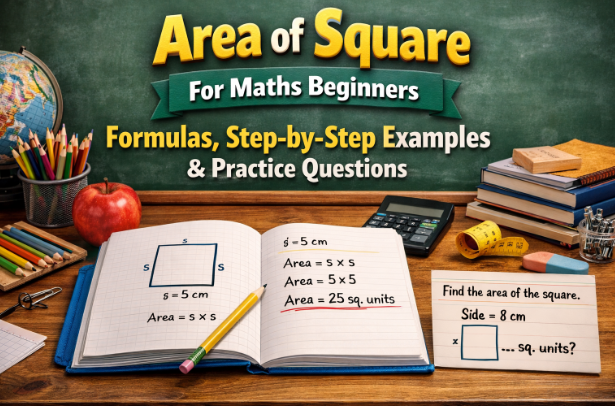
To calculate the area of a square, you use a straightforward formula: multiply the length of one side by itself. In mathematical terms, Area = side × side. This can also be expressed as side squared, often written as s².
A = s^2
Understanding the Logic
The reason this formula works is that a square can be divided into equal rows and columns. When you multiply the side length by itself, you are essentially counting how many unit squares fit inside the larger square, which defines the area of the square.
Step-by-Step Calculation Method
Step 1: Measure the Side
Begin by determining the length of one side of the square. Accurate measurement is essential because even a small error can affect the final result for the square’s area.
Step 2: Apply the Formula
Once you have the side length, square it. For example, if one side measures 5 units, then 5 × 5 equals 25. This result represents the area of a square in square units.
Step 3: Add Units Properly
Always include the correct unit of measurement, such as square meters (m²) or square centimeters (cm²). This ensures clarity when presenting the area of square in practical contexts.
Solved Examples for Better Understanding
Example 1: Small Square
If the side of a square is 4 cm, the calculation would be 4 × 4 = 16. Therefore, the area of the square is 16 cm².
Example 2: Larger Measurement
Consider a square plot with a side length of 10 meters. Multiplying 10 by 10 gives 100, so the area of the square is 100 m². This type of calculation is often used in construction and land planning.
Common Mistakes to Avoid
Confusing Perimeter with Area
One of the most frequent errors is mixing up perimeter and area. While perimeter measures the boundary, the area of a square measures the space inside. Keeping this distinction clear is crucial.
Unit Usage
Another common mistake is forgetting to square the units. Writing “cm” instead of “cm²” can lead to an incorrect interpretation of the area of a square, especially in academic or professional settings.
Practical Applications
Everyday Uses
The area of a square is widely used in home improvement projects, such as calculating the amount of paint needed for a wall or the number of tiles required for a floor.
Academic Importance
In education, understanding the area of a square builds the foundation for more complex topics like algebra, trigonometry, and calculus. It also enhances logical thinking and problem-solving skills.
Conclusion
Learning how to calculate the area of a square step by step is an essential mathematical skill with real-world relevance. From simple measurements to practical applications, this concept is both versatile and easy to master with practice. such as interactive learning, can further enhance comprehension and make the process more engaging and effective. Incorporating modern teaching methods, such as interactive learning, can further enhance comprehension and make the process more engaging and effective. By understanding the formula, following a structured approach, and avoiding common mistakes, anyone can confidently work with square measurements.