
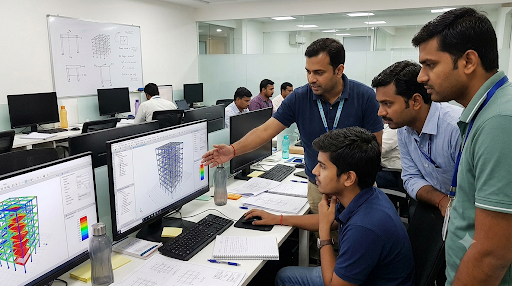
Build Your Engineering Edge: Practical ETABS Skills for Modern Structural Design
Structural engineering increasingly relies on digital tools that help professionals analyze, model, and design buildings more accurately. ETABS has become an essential software skill for engineers working on building structures, especially when practical understanding must complement theoretical knowledge.
For learners seeking flexible training, an ETABS free online course with certificate can provide an accessible starting point for developing software familiarity. Combining structural concepts with practical modelling can help students and professionals understand how loads, analysis, design, and detailing connect within a building project.
Building Practical Skills Through Digital Structural Training
Modern structural learning is becoming more practical, flexible, and focused on applying engineering concepts through software-based workflows.
1. Understanding Structural Modeling Fundamentals
Structural modeling is an essential first step in using ETABS effectively. Learners need to understand how columns, beams, slabs, walls, supports, and other structural components are represented within a digital model. This foundation helps users interpret how a building behaves under different loading conditions. Rather than treating software as a calculation tool alone, engineers can develop a clearer understanding of how modelling decisions influence analysis results and subsequent design activities.
2. Connecting Loads With Building Behaviour
Load application is another important part of structural analysis. Engineers need to understand gravity loads, lateral loads, and other relevant loading conditions before interpreting software-generated results. ETABS training can help learners connect theoretical loading concepts with practical structural models. This approach makes it easier to recognize how load paths influence structural members and how changes in assumptions can affect analysis outcomes. Understanding this relationship is valuable for both academic learning and practical design work.
3. Developing Analysis And Interpretation Skills
Using software effectively requires more than entering data and accepting the results it generates. Engineers must learn how to review structural responses, identify unusual results, and interpret analysis outputs in an engineering context. Developing these skills encourages critical thinking and helps learners understand whether a model behaves as expected. Practical assignments and project-based exercises can provide opportunities to examine results, identify potential modelling issues, and make informed adjustments before moving toward detailed structural design.
4. Applying Design Concepts To Real Projects
Real-world projects provide context that theoretical examples may not fully capture. Learners can benefit from exercises involving complete building structures, where modelling, loading, analysis, design, and documentation are considered as connected stages. Practical ETABS training can bridge the gap between classroom concepts and professional expectations by letting users work through realistic structural scenarios. This experience can also improve confidence when approaching consulting assignments or entry-level structural engineering responsibilities.
Flexible Learning Paths For Modern Structural Engineers
Flexible digital education lets learners build software skills alongside studies, work, or other professional commitments. Those exploring an ETABS free online course with certificate can begin with foundational concepts before progressing toward more detailed structural applications. Flexible online learning can be particularly useful for students and working engineers who cannot attend fixed classroom sessions. Civilera’s official learning ecosystem includes self-paced options, project-oriented training, software-focused courses, and downloadable certification across its civil engineering programs. Its free learning resources also introduce structural stability fundamentals and ETABS basics for learners looking to strengthen their foundation.
ETABS Learning Supporting Stronger Design Workflows
Understanding software within a complete structural design workflow can help learners move beyond isolated commands and develop practical engineering judgment.
1. Learning Through Complete Design Workflows
A structured design workflow helps learners understand how different stages of structural engineering connect. Instead of studying modeling, loading, analysis, and detailing separately, students can explore how each stage contributes to the final design. This broader perspective makes software learning more meaningful and helps users understand the sequence followed in professional structural consulting environments.
2. Building Skills Through Project Practice
Project-based learning gives engineers an opportunity to apply concepts to realistic building models. Working through projects can improve familiarity with software interfaces, modelling procedures, analysis settings, and design interpretation. Repeated practice also helps learners become more comfortable identifying errors and correcting them before progressing to later stages of a structural workflow.
3. Exploring Seismic And Lateral Analysis
Modern buildings may need to account for different forms of lateral loading and seismic considerations. Learning how such conditions are represented within structural models can expand an engineer’s understanding of building behaviour. ETABS training that introduces seismic analysis alongside other design considerations can help learners develop a broader view of structural analysis rather than focusing only on gravity-load conditions.
4. Connecting Analysis With Structural Detailing
Structural design does not end when analysis results are generated. Engineers also need to understand how design decisions translate into drawings and reinforcement details. Learning that connects ETABS modeling with detailing can provide a more complete picture of the design process. This connection helps learners understand how analytical decisions eventually influence practical construction documentation.
Expanding Career Skills Through Engineering Software
ETABS can form part of a wider technical skill set for professionals pursuing structural design and civil engineering careers. An ETABS online learning pathway lets students and working professionals study from different locations while staying flexible around existing commitments. Official Civilera information describes online training as self-paced, with access to project practice and support for clarification, while its broader course portfolio includes ETABS, STAAD Pro, AutoCAD, Revit, and foundation design.
Building several complementary software skills can help engineers understand different parts of the design process. ETABS supports building analysis and design, while tools such as Revit and AutoCAD support modelling, documentation, and detailing workflows. Developing these capabilities together can create a stronger technical foundation for professionals seeking broader responsibilities within structural engineering and design teams.
Conclusion
ETABS skills can help civil and structural engineering learners connect theoretical knowledge with practical modelling, analysis, design, and detailing workflows. Flexible training, project practice, and structured guidance can make the learning process more accessible while supporting continuous professional development.
For learners exploring civil engineer software courses, Civilera offers practical training focused on structural design, software applications, and real-world project work through flexible learning formats. Their ETABS programs include online and in-person options, project-based practice, certification, and expert guidance. They help students and professionals develop stronger technical skills, gain practical exposure, and build greater confidence in applying structural engineering concepts to modern design projects.