
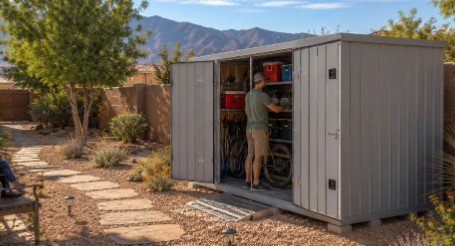
Portable Storage Buildings: The Complete Buyer’s Guide
The demand for on-site, accessible storage has driven significant growth in the portable storage buildings market — and the options available today range from lightweight plastic sheds to engineered steel structures designed for permanent outdoor placement. For buyers evaluating portable storage buildings, the differences between product categories matter enormously: construction material, structural gauge, security features, and weatherproofing determine whether a unit will serve its purpose reliably for years or require replacement within a few seasons.
What Portable Storage Buildings Are
Portable storage buildings are freestanding structures designed for outdoor placement on a property, offering storage capacity without permanent construction. Unlike built outbuildings that require permits, foundations, and professional construction, portable storage units are delivered and assembled with minimal site preparation and can be relocated if the property owner’s circumstances change.
The defining characteristic of portable storage buildings is the combination of meaningful storage capacity and the flexibility of non-permanent placement. This positions them as a practical middle ground between a small plastic shed — which offers limited capacity and minimal security — and a full outbuilding construction, which requires significant investment and permanence.
Material Categories: What to Know
Portable storage buildings are manufactured primarily from three materials: wood, resin or plastic composite, and steel. Wood structures offer an attractive appearance but require significant maintenance — painting, sealing, and periodic inspection for rot and pest damage. Resin structures are low maintenance but are limited in structural strength and security: the walls can be cut or kicked through, and the structures are not designed for heavy contents or harsh weather.
Galvanized steel portable storage units occupy the highest performance tier. Steel resists corrosion, handles high wind loads, and provides physical security that wood and resin alternatives cannot. Powder-coated steel portable storage buildings retain their finish and structural integrity for decades with minimal upkeep, making them the most cost-effective choice for anyone who plans to use their unit seriously and long-term.
Sizing Your Unit to Your Actual Needs
Choosing the right size is one of the most consequential decisions in the portable storage buildings selection process. The natural tendency is to underestimate volume needs — buyers who purchase a unit just large enough for their current contents frequently find that it fills up quickly as they take advantage of having dedicated outdoor storage for the first time.
A practical approach is to inventory the categories of items the unit will hold and estimate the floor space each category requires. Factor in whether the unit will need to accommodate future additions — seasonal equipment, a new landscaping project, additional business inventory — and size up accordingly. Portable storage units are a long-term investment, and a unit that provides room to grow delivers more value over its lifespan than one that is perpetually at capacity.
Security Features That Matter
Not all portable storage buildings are built with equivalent security. The security of a unit depends on the strength of its wall panels, the design of its door hinges, the quality of its hasp hardware, and the ease with which the lock point can be attacked. Units with exposed hinge pins can have their doors removed by an attacker who drives out the pins — regardless of how strong the lock is.
Quality portable storage units use concealed or welded hinge designs, reinforced door frames, and hasp hardware designed to accept a heavy-duty padlock. The physical resistance of the wall and door panels to cutting and prying should also be considered for units holding high-value contents. Buyers should evaluate security as rigorously as they evaluate capacity.
Placement and Local Regulations
Before purchasing portable storage buildings, buyers should verify any applicable local regulations governing outbuilding placement. Many municipalities and homeowner associations have rules governing the size, placement distance from property lines, and appearance of accessory structures — and portable storage units may fall within the definition of an accessory structure even when they are not permanently built.
Most portable storage units under a certain square footage threshold do not require a permit in most jurisdictions, but this varies significantly by location. Confirming local requirements before purchase avoids the frustration of purchasing and assembling a unit only to discover that it needs to be relocated or removed.
Conclusion
Portable storage buildings offer a practical, flexible, and permanent-construction-free path to serious on-site storage. The key to a successful purchase is matching material quality, size, and security features to the actual demands of the application. Galvanized steel portable storage units represent the highest performance option in the market — delivering the durability, security, and low maintenance that make them a reliable long-term investment for any homeowner, business, or property manager with meaningful outdoor storage needs.