
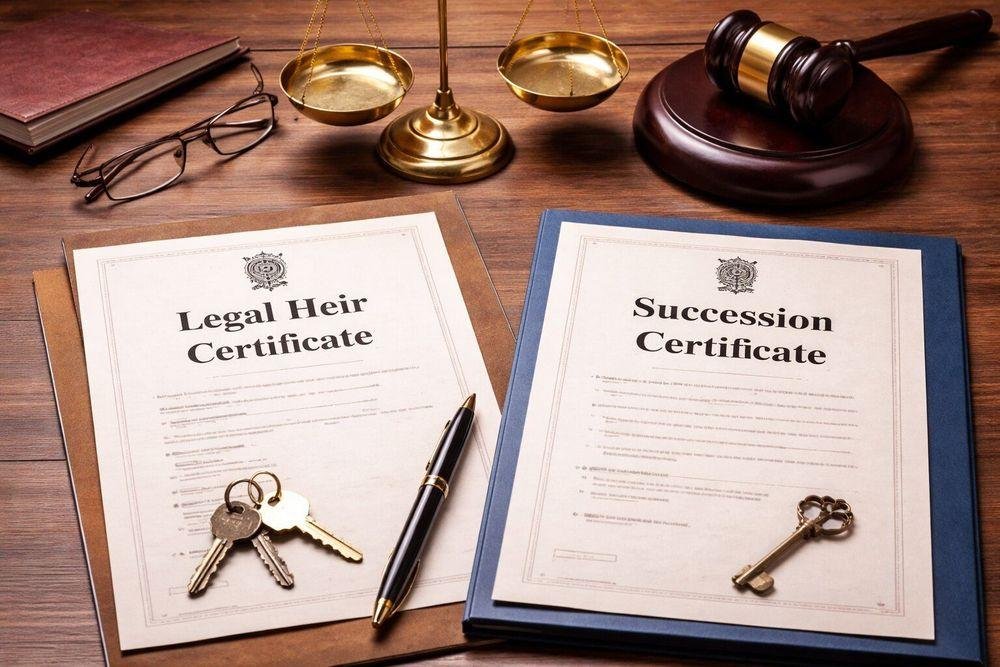
Can NRIs Apply for a Succession Certificate in Kerala? Full Guide
When dealing with inheritance matters in India, especially from abroad, understanding the legal process becomes essential. For Non-Resident Indians (NRIs), navigating the succession certificate procedure can seem complex, particularly when dealing with region-specific rules like those applicable in Kerala. This guide simplifies everything you need to know about obtaining a succession certificate Kerala, including eligibility, process, documents and practical tips.
What is a Succession Certificate?
A succession certificate is a legal document issued by a civil court that allows the legal heirs of a deceased person to claim debts, securities and other movable assets. It is especially important when the deceased has not left behind a will.
Can NRIs Apply for a Succession Certificate in Kerala?
Yes, NRIs can apply for a succession certificate in Kerala. Indian law does not restrict NRIs from claiming their inheritance rights. However, since they reside abroad, the process may involve additional steps such as appointing a representative or granting a power of attorney to someone in India.
Who Can Apply?
The following individuals are eligible to apply:
- Legal heirs (spouse, children, parents)
- Nominated representatives of the deceased
- NRIs with valid proof of relationship
Jurisdiction for Filing the Application
The application must be filed in the District Court where:
- The deceased last resided or
- The property/assets are located
For NRIs, this means filing in the appropriate court in Kerala, depending on these factors.
Step-by-Step Procedure
1. Filing the Petition
The applicant must file a petition in the District Court with details such as:
- Name and date of death of the deceased
- Details of legal heirs
- Assets and debts involved
2. Submission of Documents
Key documents include:
- Death certificate
- Proof of relationship
- Identity and address proof
- Details of assets (bank accounts, shares, etc.)
3. Court Notice
The court issues a public notice in newspapers inviting objections (if any).
4. Hearing and Verification
If no objections are raised, the court proceeds with verification.
5. Grant of Certificate
Once satisfied, the court issues the succession certificate.
Special Considerations for NRIs
Power of Attorney (PoA)
NRIs often appoint a trusted person in India through a Power of Attorney to handle the process.
Attestation Requirements
Documents executed abroad must be:
- Notarized
- Attested by the Indian Embassy or Consulate
Travel Not Mandatory
NRIs do not need to travel to India if they have authorized a representative.
Timeframe
The process typically takes:
- 3 to 6 months (if uncontested)
- Longer if objections or disputes arise
Court Fees
Kerala imposes a court fee based on the value of the estate. This fee must be paid before the certificate is issued.
Why is a Succession Certificate Important?
- Required for transferring bank balances
- Necessary for claiming shares and securities
- Helps avoid legal disputes among heirs
- Acts as legal proof of entitlement
Common Challenges Faced by NRIs
- Documentation delays
- Difficulty in coordinating with local authorities
- Legal complexities due to lack of awareness
Tips for NRIs
- Hire a local legal expert in Kerala
- Ensure all documents are correctly attested
- Maintain clear communication with your representative
- Keep multiple copies of all submitted documents
Conclusion
Applying for a succession certificate in Kerala as an NRI is entirely possible, though it requires careful handling of legal and procedural aspects. By understanding the process, preparing the necessary documentation and possibly appointing a reliable representative, NRIs can efficiently secure their inheritance rights without unnecessary complications.
If handled correctly, the process is straightforward and ensures that rightful heirs receive access to the deceased’s assets in a legally recognized manner.
This guide is prepared by taking reference from the expertise and legal insights of ezyLegal, a platform known for simplifying legal processes for individuals across India, including NRIs. By leveraging their knowledge base, the content aims to provide clear and practical guidance on how Non-Resident Indians can apply for a succession certificate in Kerala, making the process easier to understand and navigate from abroad.
Frequently Asked Questions
1. Can NRIs apply for a succession certificate in Kerala?
Yes, NRIs can apply for a succession certificate in Kerala. Indian law allows Non-Resident Indians to claim inheritance rights, either by applying directly or through a Power of Attorney holder in India.
2. What is the succession certificate procedure in Kerala?
The succession certificate procedure involves filing a petition in the District Court, submitting required documents, publishing a public notice and attending a court hearing before the certificate is issued.
3. How long does it take to get a succession certificate in Kerala?
It usually takes 3 to 6 months to obtain a succession certificate in Kerala if there are no objections. Contested cases may take longer depending on the complexity.
4. Can NRIs apply for a succession certificate without coming to India?
Yes, NRIs can apply without visiting India by appointing a representative through a Power of Attorney, which must be notarized and attested by the Indian Embassy.
5. What documents are required for a succession certificate in Kerala?
Key documents include the death certificate, proof of relationship, identity proof, address proof and details of the deceased’s assets such as bank accounts or securities.
6. Who is eligible to apply for a succession certificate in Kerala?
Legal heirs such as spouses, children and parents are eligible. NRIs who can prove their relationship with the deceased are also eligible to apply.
7. Which court issues a succession certificate in Kerala?
A succession certificate is issued by the District Court where the deceased last resided or where the assets are located in Kerala.
8. What is the court fee for a succession certificate in Kerala?
The court fee varies based on the value of the estate or assets involved and must be paid before the certificate is granted.
9. Is a succession certificate mandatory for bank account claims in Kerala?
Yes, in many cases, banks require a succession certificate to release funds when there is no nominee or will.
10. Can a succession certificate be challenged in Kerala?
Yes, any interested party can challenge the issuance of a succession certificate by raising objections during the public notice period or through legal proceedings.
11. What is the difference between a succession certificate and a legal heir certificate?
A succession certificate is used to claim financial assets like debts and securities, while a legal heir certificate identifies the rightful heirs of the deceased.
12. Is Power of Attorney mandatory for NRIs applying for a succession certificate?
No, it is not mandatory, but it is highly recommended as it allows a trusted person in India to handle the legal process on behalf of the NRI.