
How to Become a Network Technician: The Subnet Math Test
Anyone can plug an Ethernet cable into a wall. Anyone can buy a router from a big-box store and click “Next” until the Wi-Fi turns on.
But if you want to learn how to become a network technician in a corporate environment, you cannot just memorize the names of hardware. You have to understand how to control the invisible flow of data. The exact moment a beginner transitions into a hireable professional is the day they master “Subnetting.”
Subnetting is the dividing line in the IT industry. It separates the people who reset passwords from the engineers who build the infrastructure.
The Broadcast Storm: Why Subnetting is Required
Imagine a massive warehouse with 1,000 employees. If the CEO tells everyone to stand in the same room and shout their conversations at the same time, nobody can hear anything. The noise is paralyzing.
Computer networks work exactly the same way. When a computer needs to find a printer, it sends out a “Broadcast” message. It physically shouts to every other device on the network. If you put 1,000 computers on the exact same network, the constant shouting creates a “Broadcast Storm.” The network chokes on its own traffic, and the entire system crashes.
To fix this, you must build walls. You must take that one massive room and slice it into smaller, isolated rooms. In networking, this is called a Subnet.
The IP Address and the Slash Notation (/24)
To build a digital wall, you do not use physical bricks. You use binary math.
When you look at an IP address like 192.168.1.0/24, you are not just looking at a computer’s name. You are looking at a mathematical equation. Computers do not read the number “192.” They only read binary code: strings of 1s and 0s.
An IP address is made of exactly 32 bits. The /24 at the end (called CIDR notation) tells the computer’s processor exactly how many of those bits are locked down for the “Network” side, and how many are left over to hand out to the “Host” computers. A standard /24 network gives you exactly 256 IP addresses to use.
But as we established, you do not want 256 computers in the same room. You need to slice that number down.
Slicing the Network into Four Secure Rooms
Let’s look at a concrete example. A company has four distinct departments: HR, Accounting, Sales, and IT.
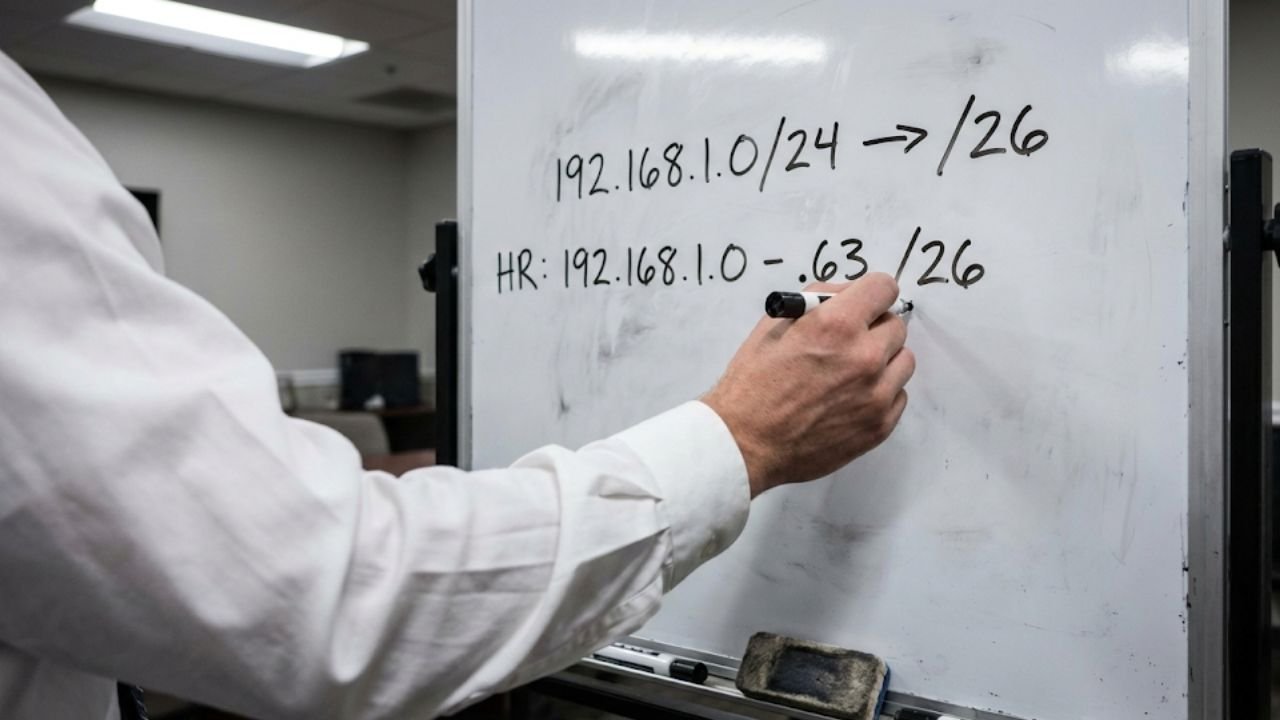
You cannot let the Sales team see the Accounting department’s servers. You must physically and digitally separate them. To do this, a technician “borrows” bits. They change the math from a /24 to a /26. By shifting the binary math by just two digits, the technician instantly chops that single massive network into four perfectly isolated subnets, each holding 64 addresses.
- Subnet 1: 192.168.1.0 (HR Department)
- Subnet 2: 192.168.1.64 (Accounting Department)
- Subnet 3: 192.168.1.128 (Sales Department)
- Subnet 4: 192.168.1.192 (IT Department)
Now, if an HR employee tries to print a highly confidential payroll document, that data physically cannot cross over to the Sales network. The core office router looks at the subnet mask, sees the mathematical wall, and drops the traffic. You did not buy a second router. You did not run new copper cables. You secured the entire building using pure mathematics.
The Whiteboard Interview: Proving You Can Do the Job
This is the exact reason why subnetting is the ultimate filter in job interviews.
When you apply for a network infrastructure job, the IT Director will not ask you a multiple-choice question about what a switch does. They will hand you a dry-erase marker, write an IP address on the whiteboard, and say, “Break this network into six departments with 30 hosts each.”
If you freeze, the interview is over. You cannot guess binary math. You either know the formula, or you don’t.
That is why piecing together free YouTube videos rarely works. To pass the whiteboard test, you need structured, hands-on repetition. Taking a rigorous course through a dedicated computer network technician training program forces you to do the math on paper until it becomes second nature.
The Verdict
You become a network technician when you stop relying on automatic settings and start manually dictating where the data goes. By mastering Subnetting, you learn to look at a simple string of numbers and instantly visualize the physical and digital layout of a corporate building.