
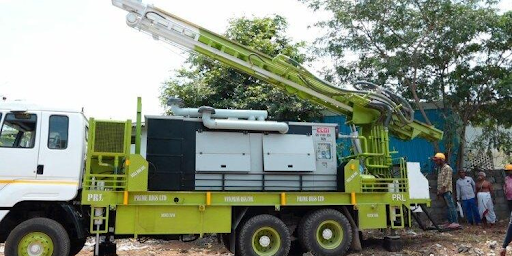
Equipment and Drilling Manufacturers: Pillars of Today’s Construction Advancements
Introduction
Modern infrastructure projects rely on the coordinated operations of construction equipment and drill manufacturing businesses. High-rise structures, bridges, roads, rail systems, and buried utilities all need both visible heavy equipment and reliable subsurface performance. Construction equipment provides the mobility, lifting and earth-moving capabilities to fashion and prepare sites. Drill manufacturing companies provide the rigs, tooling, consumables and engineering expertise necessary for safe, accurate drilling and effective sub-surface operations. This article explores some areas where these two sectors combine to promote productivity, safety, environmental stewardship and economic value on construction projects.
1. Foundations of progress: Why construction equipment matters
Construction equipment is the practical manifestation of design intent into a built asset. Excavators, cranes, bulldozers, graders, compaction and loaders move, place, and form large quantities of material with speed and repeatability that manual operations cannot compare. The capabilities of construction equipment (digging force, reach, lifting capacity, control resolution) dictate what is possible within a project’s sequence and temporary works. Hydraulics, materials, operator ergonomics and onboard diagnostics have improved machine uptime and human fatigue, making schedules more reliable and allowing more ambitious programs of work.
2. Precision and power: The role of drill manufacturers
Drill manufacturing companies supply the subsurface accuracy that supports long-lasting foundations, anchoring systems, and utility bores. Rigs, augers, core barrels, bits, and rods are designed to withstand abrasive wear, stay aligned at depth, and handle spoil removal through a wide range of ground conditions and rock types. Drilling system designers optimize cutter geometries, choose wear-resistant alloys, and balance drive trains for efficient penetration without compromising accuracy. In addition to hardware, drill manufacturing companies provide engineering advice, recommended practices, and field support that help contractors adapt drilling processes to local geology and structural requirements.
3. Productivity improvements through mechanization
Mechanization results in tangible productivity benefits by lowering cycle times and generating repeatable output. Bulk earthworks and material handling are possible at rates that compress schedules, and specialized drilling rigs reduce the calendar associated with piling, anchors and boreholes. Automation features such as automatic grade control, programmable sequencing, and adaptive feed systems enable machines to run long shifts with minimal manual intervention. Drill manufacturing companies also play a role by improving bit design and feed systems so that drilling cycles are consistent, tooling longevity is increased, and crew productivity increases.
4. Safety enhancements and risk mitigation
Modern equipment and tooling have been revolutionized through safety. Construction equipment features rollover protection, 360-degree envelope visibility, proximity alert, and auto-shutoff capabilities that reduce the likelihood of site accidents. Stabilizing frames, torque limiters, vibration isolators and secure anchoring capabilities are installed on the drilling rig to reduce the likelihood of spontaneous failure that could cause harm to personnel or surrounding structures. The introduction of remote-control and semi-autonomous control of both heavy equipment and drilling rigs further restricts the need for human intervention in dangerous zones, while improved diagnostics allow teams to identify issues before they become incidents.
5. Resource efficiency and environmental stewardship
Environmental performance is becoming a growing criterion in equipment and drilling choices. Hybrid and electric drivetrains, low-emission power units, and designs for enhanced fuel economy reduce local air pollution and greenhouse gas emissions from construction equipment. These include manufacturers’ commitment to low-spoil tooling and processes that allow closed-loop drilling fluid processing and reduce the risk of groundwater contamination as part of a sustainable drilling process. Suppliers and contractors that adopt lifecycle thinking, with component remanufacturing, optimized logistics with reduced transportation emissions and end-of-life recovery options, deliver infrastructure with smaller ecological footprints.
6. Versatility for challenging site conditions
Construction sites come in all shapes and sizes: small urban parcels, steep or swampy ground, and layer-cake geology all create different constraints. High-power-to-size ratio construction equipment allows efficient working in spaces; modular drilling rigs and quick-change tooling allow flexibility to change between diameters, depths, and drilling systems without major downtime. Drill manufacturing firms also produce portable rigs and mounting interfaces that are compatible with different carriers, allowing geotechnical teams to react swiftly in the event of unforeseen changes in ground conditions during execution.
7. Economic impacts and life cycle value
Equipment procurement decisions are strengthened by consideration of total life cycle cost, rather than acquisition cost alone. Well-constructed construction gear and durable drilling rigs usually have lower operating costs due to fewer repairs, more consistent maintenance schedules and higher resale values. In addition, drill manufacturing companies that offer network services for spare parts, refurbishing programs and training services ensure that owners optimize uptime and mitigate the risk of expensive project delays. When productivity improvements from mechanization are complemented with smart management of the lifecycle, projects benefit from improved cost management and higher returns to stakeholders.
8. Innovation, digitalization, and the future of site operations
Digitalization is connecting construction equipment and drill manufacturing companies into an interconnected data ecosystem that improves decision-making and cuts down waste. Telematics and GPS-guided machine control enable construction equipment to work to tight tolerances and to integrate directly into digital project models. Drilling tools equipped with instrumentation provide real-time torque, rate of penetration and subsurface resistance data that feeds analytic engines and drives adaptive drilling strategies. By aggregating data across projects, cloud platforms can perform predictive maintenance, optimize tool selection by geology, and constantly optimize field practices.
9. Global value chains and sectoral collaboration
Construction and drilling equipment: The construction and drilling sectors have supply chains that are global in nature to source specialist parts and materials. Industrial equipment manufacturers are working together to develop and share best practices and standardize equipment specifications to increase interoperability. A new ecosystem is formed where contractors, manufacturers and technology providers can come together to deliver equipment more quickly, with improved quality and greater innovation at scale. This international collaboration ensures that infrastructure development is based on a broad pool of knowledge, research and technological progress from all over the world.
Conclusion
Manufacturing companies of construction equipment and drill are a realistic and technological alliance that defines the efficiency, safety and sustainability of infrastructure delivery. When contractors, owners and engineers choose machines and drilling systems that make sense on their lifecycle, flexibility and digital preparedness, projects are better set for budget, safety and environmental success. Sustained collaboration between operators, drill manufacturing companies and project teams – supported by training, sharing of information and iterative innovation – will be central to meeting infrastructure demands as populations grow while minimizing cost and environmental impact.