
BAER Test for Dogs: Hearing Assessment & Diagnosis Guide
Responsible dog owners recognize hearing problems when pets don’t respond to verbal commands or show behavioral changes suggesting auditory dysfunction. A BAER test for dogs (Brainstem Auditory Evoked Response) provides an objective hearing assessment impossible through behavioral testing alone. This comprehensive guide explains BAER testing, when veterinarians recommend hearing tests, what results mean, and how diagnosis guides treatment and management decisions.
Understanding BAER Testing
What BAER Testing Measures
BAER testing (Brainstem Auditory Evoked Response) evaluates:
- Ear function (cochlea, inner ear structures)
- Auditory nerve function (CN VIII nerve integrity)
- Brainstem pathways (auditory processing centers)
- Hearing thresholds (sensitivity levels in each ear)
The test measures electrical brain activity generated by sound stimulus, determining whether sound travels properly from ear to brainstem.
How BAER Testing Works
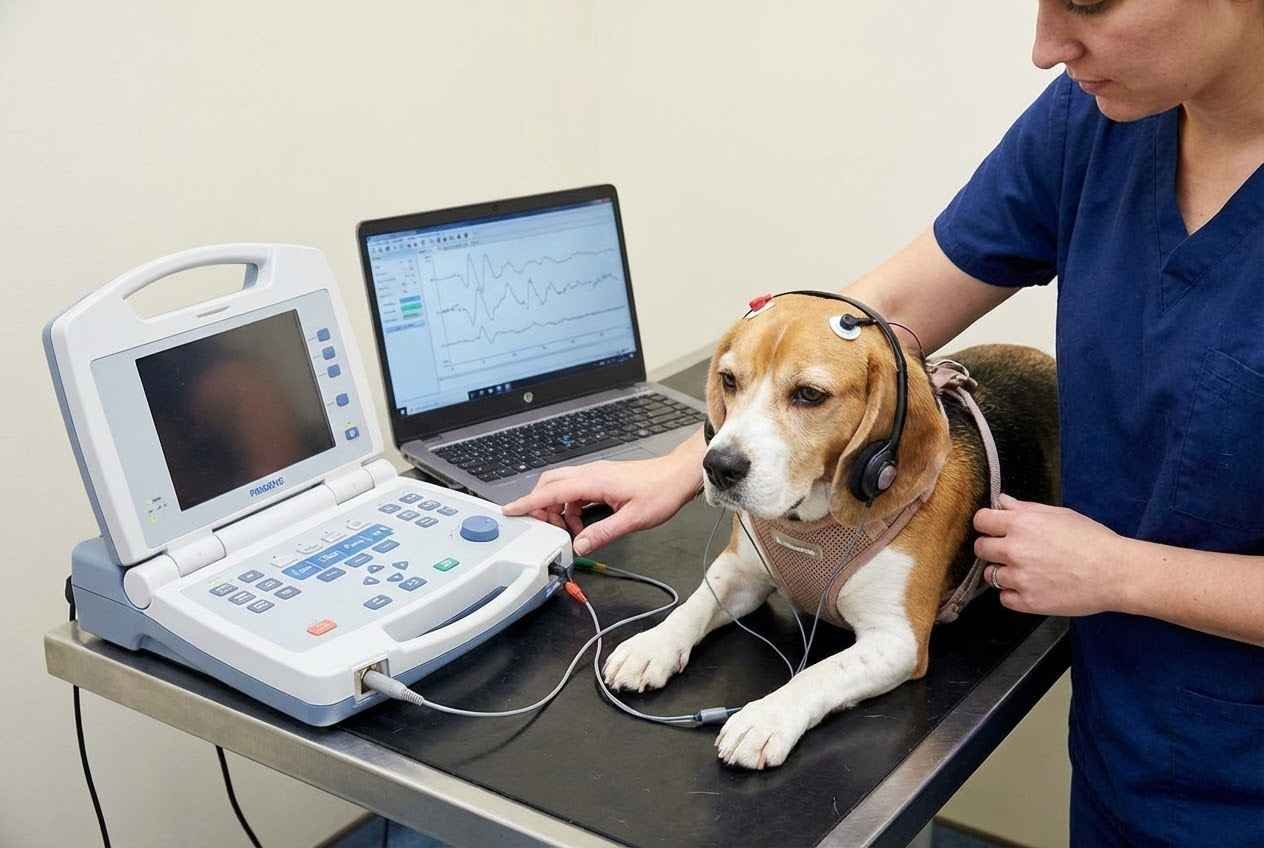
- Electrode placement: Small electrodes attach to scalp (painless, non-invasive)
- Sound stimulus delivery: Click sounds delivered through earphones at progressively lower volumes
- Brain wave recording: Specialized equipment detects electrical signals generated by auditory pathways
- Waveform analysis: Technicians interpret resulting waveforms determining hearing function
- Threshold determination: Testing continues until minimum audible level determined for each ear
The objective measurement proves far more reliable than behavioral testing, particularly in dogs with partial hearing loss.
When BAER Testing Is Recommended
Congenital Deafness Screening
Breed-specific risk: Certain breeds show high congenital deafness prevalence:
- Dalmatians (20-30% prevalence)
- Bullterriers (20-25%)
- Boxers (3-5%)
- Collies, Australian Shepherds (5-10%)
Responsible breeders BAER test dogs before breeding to prevent hereditary deafness transmission.
Timing: Testing recommended at 6-8 weeks of age (earliest reliable assessment).
Acquired Hearing Loss Assessment
Adult dogs developing hearing loss benefit from BAER testing determining:
- Unilateral vs. bilateral loss (one ear vs. both)
- Severity (mild, moderate, severe, complete loss)
- Pattern (high-frequency vs. low-frequency)
Proper assessment guides management decisions.
Neurological Investigation
Dogs with neurological signs (facial nerve paralysis, head tilting, balance problems) may have brainstem involvement. BAER testing evaluates:
- Auditory pathway integrity
- Associated neurological damage
- Brainstem disease extent
BAER abnormalities help localize neurological lesions.
Post-Surgical Monitoring
Dogs undergoing ear surgery or procedures near auditory structures benefit from:
- Pre-operative baseline testing
- Post-operative assessment
- Determination of hearing preservation
Objective measurements guide surgical outcomes better than behavioral assessment.
BAER Test Results Interpretation
Normal Results
Bilateral hearing normal: Both ears respond to sound at normal thresholds; no treatment required; normal lifespan expectations.
Unilateral loss: One ear deaf (or significantly hearing-impaired) while other functions normally; dog functions well; normal lifespan.
Abnormal Results
Bilateral deafness: Complete hearing loss both ears; requires significant management adaptation.
Partial hearing loss: Reduced sensitivity; may progress; management depends on severity.
Asymmetrical loss: One ear worse than other; specific to inner ear or auditory nerve.
Central auditory dysfunction: Rare pattern suggesting brainstem involvement; warrants neurological evaluation.
Congenital vs. Acquired Deafness
Congenital Deafness (Present at Birth)
Cause: Genetic abnormality (often linked to white coat color genes)
Age of onset: Present from birth (noticed by 4-6 weeks)
Progression: Non-progressive (doesn’t worsen)
Bilateral risk: 50% prevalence in high-risk breeds
Prevention: Selective breeding away from affected lines
Puppies with congenital bilateral deafness cannot be returned to breeders once identified; lifelong commitment required.
Acquired Deafness (Develops Later)
Causes:
- Chronic ear infections (otitis media/interna)
- Ototoxic medications (some antibiotics, diuretics)
- Ear trauma or surgery complications
- Age-related (presbycusis, normal aging)
- Disease (meningitis, head trauma)
- Neoplasia (tumors involving auditory structures)
Age of onset: Variable (puppyhood to geriatric years)
Progression: Often progressive if underlying cause not addressed
Prognosis: Depends on underlying cause and treatability
Management of Deaf Dogs
Environmental Modifications
- Safety measures: Keep deaf dogs indoors or in securely fenced areas (can’t hear vehicles, dangers)
- Visual signals: Train hand signals replacing verbal commands
- Vibration alerts: Teach response to floor vibrations, vibrating collars
- Sleeping locations: Place sleeping area where dog can see household activities
Training Adaptations
- Hand signals: Deaf dogs learn hand signals as effectively as hearing dogs learn verbal commands
- Touch training: Use touch cues initiating behavioral responses
- Reward-based methods: Motivation remains high despite hearing loss
Deaf dogs successfully complete obedience training with modified methods.
Quality of Life
Many deaf dogs enjoy excellent quality of life with:
- Normal lifespan: Deafness alone doesn’t reduce longevity
- Normal activity levels: Blind dogs often compensate with heightened other senses
- Normal behavior: No personality changes from hearing loss
Deaf dogs thrive with appropriate management, continuing full family participation.
Genetic Testing & Breeding Decisions
Dogs with identified congenital deafness should not be bred to prevent hereditary disease transmission. Responsible breeders:
- BAER test before breeding
- Screen puppies at appropriate age
- Provide hearing test documentation
- Advise buyers of hereditary risk
These practices gradually reduce congenital deafness prevalence in susceptible breeds.
Hearing Aids & Emerging Treatments
Hearing Aids
Limited success in dogs due to:
- Small ear canals
- Behavioral tolerance issues
- Cost ($3,000-6,000+)
While technically feasible, behavioral and practical limitations limit widespread adoption.
Gene Therapy Research
Emerging research explores gene therapy correcting genetic mutations causing congenital deafness. Early-phase studies show promise but remain unavailable clinically.
Conclusion
A BAER test for dogs provides objective hearing assessment guiding responsible breeding decisions, management planning, and neurological investigation. Understanding hearing test results empowers dog owners to make informed decisions about treatment, management, and breeding. Whether screening puppies or assessing adult hearing loss, professional BAER testing provides clarity impossible through behavioral assessment alone.