
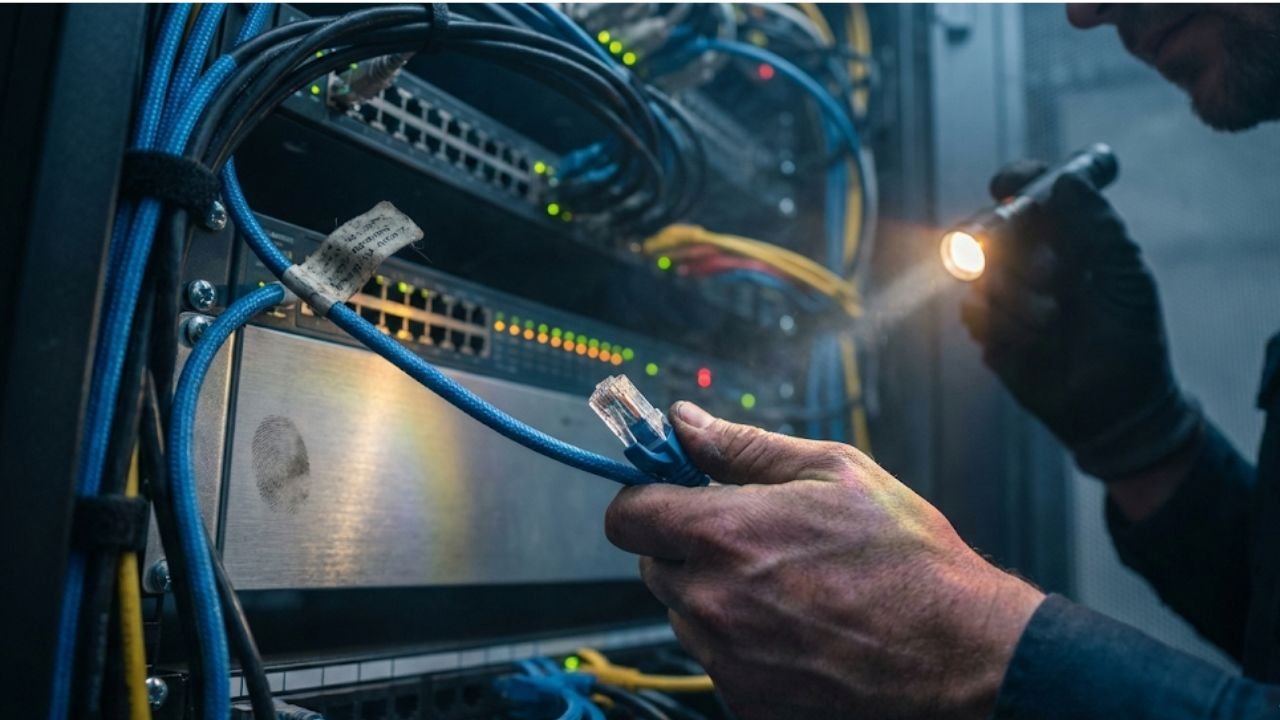
The Physicality of Data: Why Networking is a “Blue-Collar” Tech Skill
We often talk about the internet as if it’s a ghost—a “cloud” that exists somewhere in the atmosphere, magically delivering video and emails to our pockets. But the truth is that the internet is a physical place. It is a world made of copper wires, glass fibers, humming server racks, and plastic switches. If a single cable is bent too sharply or a port is configured with the wrong rule, the “ghost” disappears.
What this means is that behind every wireless signal is a physical connection that someone had to plan, plug in, and test. It is a job for people who like to see how things fit together and who enjoy the satisfaction of a perfectly organized workspace.
Earning a computer network support specialist certification is how you learn to master this physical world. It ensures that the hardware, invisible to most people, works perfectly every time, turning you into a digital architect who builds the roads that data travels on.
The Architecture of the Switch
In a typical office building, there is usually a small, locked room that hums with the sound of cooling fans. This is the heart of the network. Inside, you’ll find “Switches” and “Routers”—the mail sorting facilities of the digital world.
A technician’s job is to act as the foreman of this room. You aren’t just “managing IT”; you are physically “punching down” wires into a patch panel and ensuring that every desk in the building has a direct, clean line to the server. And that’s why a good technician spends as much time with a label maker and a cable tester as they do with a keyboard. There is a specific kind of pride in looking at a server rack where hundreds of blue cables are neatly zip-tied and color-coded, knowing exactly where every single one leads.
The Logic of the “Packet”
Once the wires are in place, you have to set the “Rules of the Road.” In the industry, these are called protocols, but you can think of them as traffic lights. Without them, every computer would try to talk at once, and the network would crash under the noise.
- Setting Priorities: You learn how to make sure a surgeon’s remote video feed has priority over a guest in the waiting room watching YouTube.
- Creating Maps: You learn “Topology,” which is essentially drawing the blueprint of how information flows so it takes the shortest, fastest path.
- Security Gates: You configure firewalls that act as physical barriers, stopping unauthorized “traffic” from entering private folders.
What this means is that you aren’t just a repair person; you are a strategist. You decide how the “neighborhood” of the office is laid out so that no one gets stuck in a digital traffic jam.
Troubleshooting as a Detective Story
When the Wi-Fi goes out, most people just get frustrated. A network specialist, however, gets to work on a puzzle. You don’t just “restart the box” and hope for the best. You follow the signal.
You might use a tool to “ping” a server, watching how long it takes for a packet of data to bounce back. If the lag—or “latency”—is too high, you start tracing. Is it a bad connector? Is a microwave in the breakroom causing interference? Or did a software update change the “handshake” between two devices?
So, when the network fails, you are the detective. You use the logic you learned during your training to narrow down a thousand possibilities into one specific fix. It’s about following a logical path until the lights on the router turn from amber to green.
The Quiet Professional
There is a unique satisfaction in this field that you don’t find in many other tech jobs. It is the feeling of building something that works. When a new office building opens, and hundreds of people plug in their laptops and instantly get to work, it’s because a technician spent hours in a dark room making sure the infrastructure is sound.
What this means is that your work is the foundation for everything else. You are the one who understands the physical reality of the digital age. By focusing on the hardware and the fundamental rules of connectivity, you build a career that is as solid as the cables you install. You become the person who keeps the world connected, one perfectly crimped wire at a time.